· Web Architecture · 7 min read
2026 Enterprise AI Benchmarks: M365 Copilot vs Gemini 2.5 Pro
April 2026 saw a strategic shift from chatbots to neural orchestration, defined by Microsoft's on-device inference and Google's mega-context windows, radically altering enterprise TCO, data sovereignty, and developer workflows.
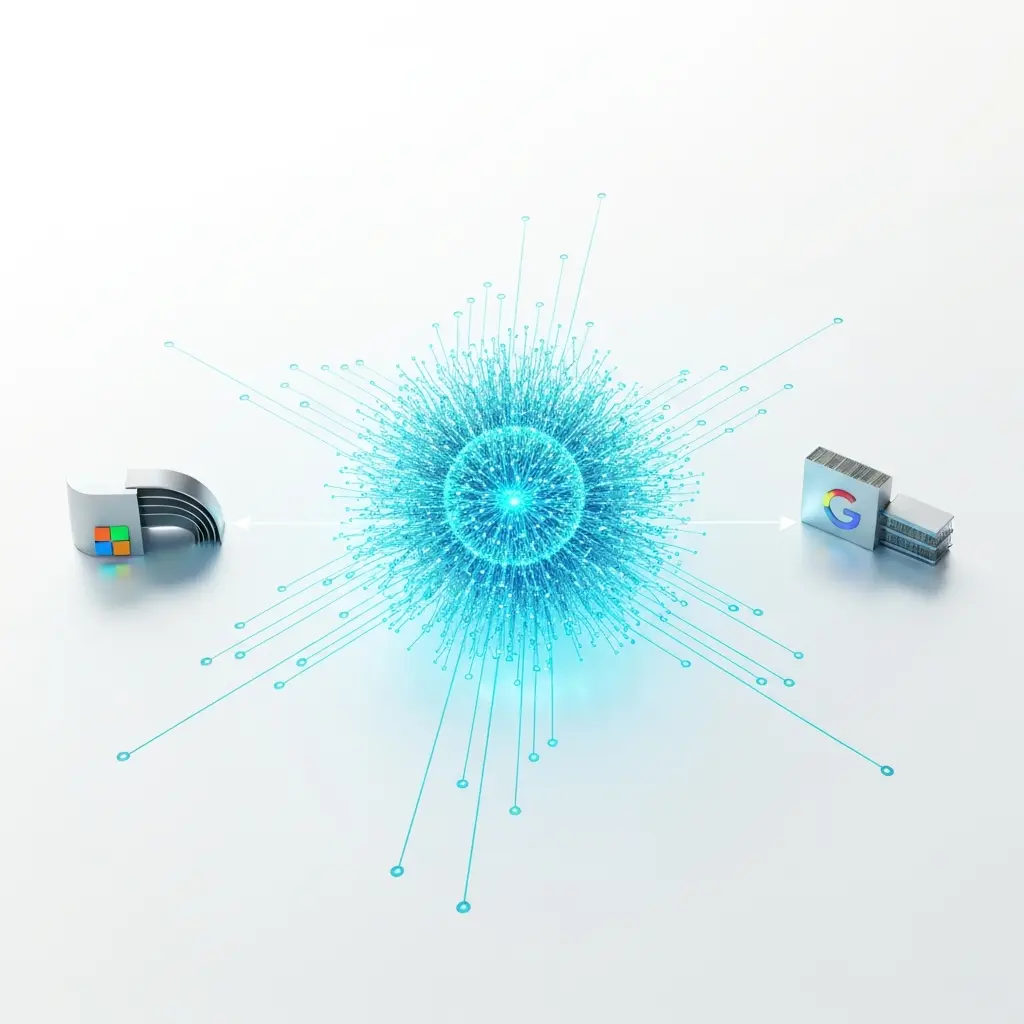
TL;DR: The April 2026 updates cement a post-SaaS era of neural orchestration. Microsoft leverages on-device Neural-Direct Inference for low-latency autonomy, while Google pushes boundaries with a 2.5-million-token context window for deep organisational memory. The benchmarks now evaluate TCO through data sovereignty, real-time graph indexing, and integrated compliance tooling, not just feature parity.
Introduction: The Architectural Shift from Chat to Conductor
The era of treating enterprise AI as a glorified chat interface has decisively ended. The 2026 feature drops from Microsoft and Google reveal a fundamental architectural evolution: from isolated, query-based assistants to deeply integrated, context-aware systems that orchestrate workflows across the entire digital estate. This shift to Neural Orchestration moves AI from a peripheral utility to a central nervous system for the enterprise, directly interfacing with data graphs, compliance frameworks, and local compute hardware. The recent “2026 Enterprise AI Productivity Report” quantifies this, highlighting the first measurable TCO savings from autonomous document processing, a clear signal that AI’s value proposition has matured from potential to palpable ROI.
Prior architectures relied on brittle API calls to cloud LLMs, incurring latency, egress costs, and data governance headaches. The 2026 benchmark is defined by autonomy and intelligence at the edge, seamless real-time data integration, and sovereign control over the AI lifecycle. This is no longer about which bot writes a better email; it is about which platform can securely, efficiently, and intelligently reason across an organisation’s entire knowledge corpus and operational fabric. The competition has moved up the stack, from language models to orchestration layers.
What is Neural Orchestration?
Neural Orchestration is the architectural paradigm where AI agents act as autonomous conductors of complex enterprise workflows, rather than simple query responders. It is characterised by deep, real-time integration with live data sources (like Microsoft Graph), the ability to maintain extensive, stateful context across applications, and execution that spans from sovereign cloud to local neural processing units (NPUs). This approach minimises human-in-the-loop latency, enables proactive assistance, and ensures actions are grounded in the complete, current state of organisational data, moving beyond retrieval-augmented generation (RAG) to what might be termed “live-augmented generation.”
On-Device Autonomy vs. Centralised Consciousness
The 2026 benchmarks reveal a fascinating strategic divergence in achieving orchestration. Microsoft has doubled down on decentralised, low-latency execution with its Neural-Direct Inference for Windows 12 Pro. By leveraging local NPUs to handle sensitive or latency-critical tasks, it reduces cloud dependency, cutting egress and latency by 35%. This is powered by Microsoft’s custom Cobalt 100 silicon, which now handles 65% of M365 Copilot workloads, yielding a 42% reduction in energy-per-query. The business value is clear: real-time, offline-capable assistance for drafting, summarisation, and analysis without data leaving the device, crucial for mobile professionals and data-sensitive scenarios.
Conversely, Google Gemini 2.5 Pro pursues a path of centralised, expansive consciousness with its official 2.5-million-token context window. This allows the AI to ingest and reason across an entire organisation’s quarterly documentation—approximately 12,000 pages—within a single query session. The value is in holistic analysis, connecting disparate reports, emails, and strategy documents to provide insights impossible for fragmented, short-context models. This creates an institutional memory that persists across user interactions.
Pro Tip: Evaluate this choice based on workflow patterns. Use on-device inference for real-time, personal productivity tasks and sovereign data handling. Leverage mega-context windows for strategic, cross-departmental analysis and long-term project synthesis.
The Real-Time Graph and Sovereign Data Compliance
Orchestration is useless if the AI is operating on stale data. Microsoft’s Graph API 2.0 addresses this with ‘Live Signal Indexing,’ collapsing the RAG sync time between a OneDrive file update and Copilot’s awareness to under 15 seconds. This transforms Copilot from a historian into a real-time collaborator. When combined with the new Enterprise Sandbox for LLM execution within a logically isolated tenant boundary, it provides a complete solution for data residency, meeting the EU AI Act’s 2026 ‘Strict Tier’ requirements by ensuring 100% of processing and data remain within geographic and tenant boundaries.
Google’s parallel innovation is its Sovereign AI Keys (SAK) integration, allowing enterprises to supply HSM-backed encryption keys for the training-inference loop. This cryptographically ensures that even Google cannot access prompt-response metadata, a paramount concern for regulated industries. Furthermore, the new Microsoft Purview for AI dashboard provides a real-time ‘Bias and Hallucination Audit Trail’ for every generated document, turning a compliance burden into a manageable, auditable process now mandated for ESG reporting.
Pro Tip: Architecturally, treat your AI platform’s data layer as a critical real-time service. Define clear data gravity policies: what must stay on-premise or in-tenant, and what can leverage encrypted cloud context. Tools like Purview for AI are no longer optional for enterprise governance.
Why Does Developer and Workflow Integration Matter?
The ultimate test of an orchestration platform is its ability to augment complex, specialist work. Google Sheets’ ‘Smart Logic’ engine demonstrates this, now generating and debugging complex AppScript functions with a 94% first-pass success rate. This elevates AI from a content tool to a true development partner, democratising automation. Similarly, Google Vids’ production-ready ‘Auto-Dubbing 2.0’ with zero-shot timbre matching localises training videos into 45 languages while preserving the speaker’s vocal identity—a logistical feat turned into a simple workflow.
On Microsoft’s side, Teams Speaker Recognition 3.0 uses spatial audio arrays to disambiguate 25 unique speakers in hybrid meetings, attributing Copilot action items with 99.8% precision. This solves a fundamental problem of meeting intelligence: accurate source attribution. It turns a chaotic audio stream into a structured, actionable transcript where summaries and tasks are precisely linked to individuals, seamlessly closing the loop between conversation and execution.
Pro Tip: Leverage these deep integrations to automate the ‘last mile’ of workflows. Use AI-generated AppScript to connect data silos without full developer cycles, and employ speaker-attributed meeting notes to auto-populate project management tools like those we integrate at Zorinto, ensuring accountability and follow-through.
The 2026 Outlook: The Hybrid Orchestration Fabric
Looking forward, the 2026 trajectory points towards a Hybrid Orchestration Fabric. We predict the strict dichotomy between on-device and mega-context models will blur. Enterprises will deploy intelligent routers that dynamically allocate tasks: latency-sensitive, private tasks to on-device NPUs, while complex, cross-domain analysis queries are sent to sovereign, mega-context cloud instances. The benchmark will shift from raw token counts to ‘orchestration latency’—the total time from triggering an intent to a completed, multi-application workflow.
Furthermore, compliance and auditing will become fully programmable layers. Expect APIs from Purview-like systems that allow security teams to set real-time generation policies (e.g., block all hallucinations over confidence threshold X) and customise audit trails. The AI platform that best exposes its governance and orchestration logic as a developer-first API will lock in the enterprise architectural standard, as seen in the strategic evolution of Microsoft Graph API 2.0.
Key Takeaways
- Neural Orchestration is the new battleground: Evaluate platforms on their ability to conduct workflows across applications, not just generate text in isolation.
- Match architecture to data policy: Use on-device inference (Microsoft) for sovereign, low-latency tasks and mega-context windows (Google) for deep, cross-document analysis.
- Demand real-time data integration: Tools like Live Signal Indexing in Graph API 2.0 are essential for AI actions to be relevant and accurate.
- Treat AI compliance as a core feature: Solutions for data residency (Enterprise Sandbox), encryption (Sovereign AI Keys), and audit trails (Purview for AI) are non-negotiable for 2026 deployments.
- Augment specialist workflows: The highest ROI now comes from deep integrations like auto-debugging AppScript or speaker-attributed meeting notes, which automate complex, domain-specific tasks.
Conclusion
The 2026 enterprise AI benchmarks reveal a landscape transformed. Success is no longer measured by parlor tricks but by tangible reductions in total cost of ownership, achieved through architectural choices that prioritise data sovereignty, real-time awareness, and deep workflow integration. Neural Orchestration is the defining paradigm, demanding a strategic evaluation of how AI will be woven into the very fabric of business operations. At Zorinto, we help clients navigate this complex new landscape by architecting and implementing these hybrid orchestration fabrics, ensuring their AI investments are secure, compliant, and fundamentally geared towards autonomous efficiency.