· Web Architecture · 8 min read
Mastering Multi-Agent Orchestration with n8n v2.14 & MCP
n8n v2.14 pivots to the Model Context Protocol, turning low-code workflows into standard tools for hierarchical, secure, high-performance multi-agent systems.
TL;DR: n8n’s 2026 v2.14 release marks a strategic pivot towards the Model Context Protocol (MCP), transforming workflows into universal endpoints for AI agents. This enables secure, hierarchical multi-agent orchestration with a tenfold performance boost, positioning n8n as a core engine for sovereign AI and complex business automation stacks.
Introduction: The Interoperability Problem in Agentic Automation
Until recently, integrating AI agents into business automation was an exercise in bespoke engineering. Each Large Language Model (LLM) ecosystem—Claude, ChatGPT, Gemini—required its own custom tooling API, forcing developers to write and maintain unique adapters. This fragmented approach created vendor lock-in, hindered scalability, and introduced significant security overhead. The late March 2026 releases of n8n v2.14.1 (Beta) and v2.13.3 (Stable) address this core architectural challenge head-on by fully embracing the Model Context Protocol (MCP) as the primary standard for AI agent interoperability. This shift repositions n8n workflows from isolated automation scripts into standardised, plug-and-play tools for any LLM, effectively becoming the “USB-C” port of the agentic world.
What is the Model Context Protocol (MCP)?
The Model Context Protocol is an open standard that defines a common language for AI agents to discover, invoke, and interact with external tools and data sources. Think of it as a universal driver that allows any compliant LLM—from Claude Desktop to a private enterprise model—to seamlessly connect to and utilise capabilities exposed by a server. In the context of n8n v2.14, the workflow engine itself becomes a powerful MCP server, exposing its entire graph of nodes, data transformations, and integrations as a structured toolkit for AI agents. This standardisation is the linchpin for the next generation of low-code agentic workflows, moving from single-actor scripts to complex, collaborative multi-agent systems.
The Architectural Shift: From Workflow to Agent Endpoint
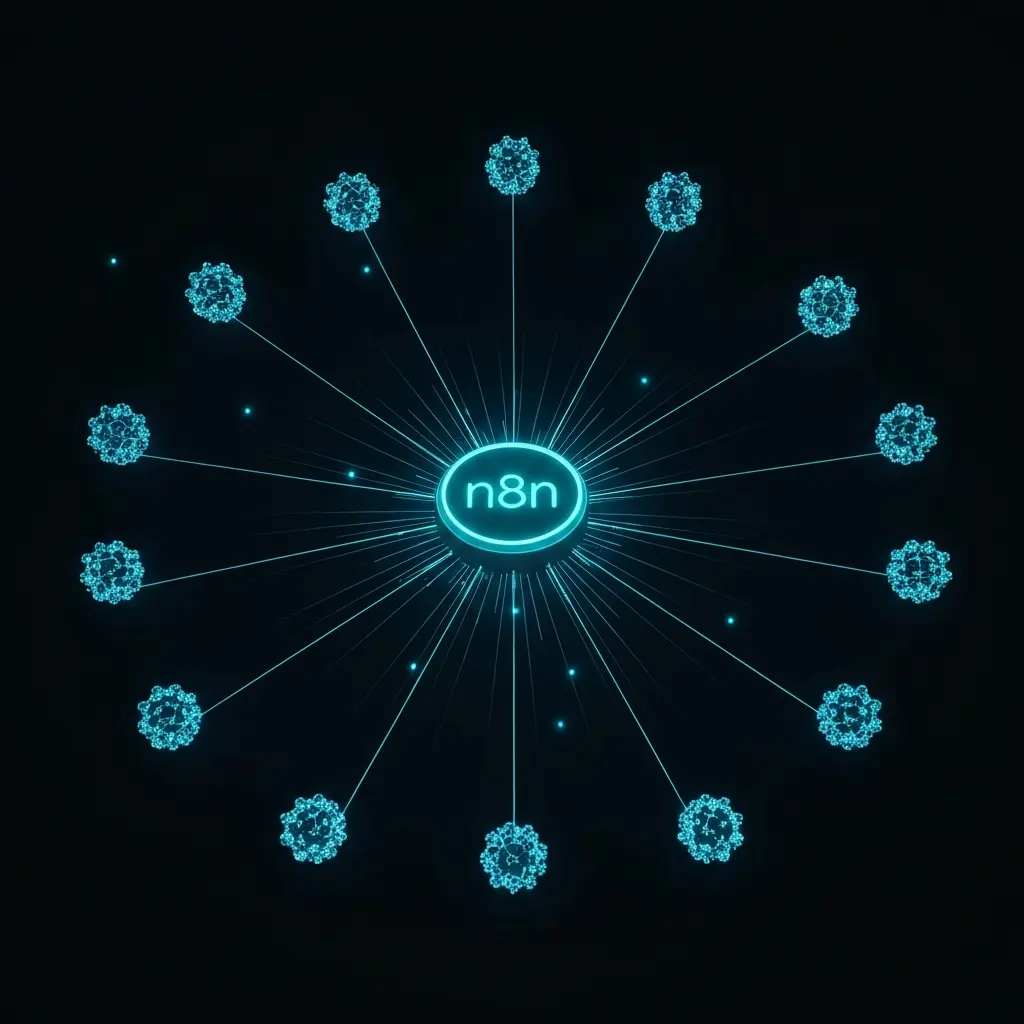
n8n’s native MCP support is delivered through two dedicated nodes: the ‘MCP Server Trigger’ and the ‘MCP Client Tool’. The Server Trigger allows a workflow to be initiated directly by an external MCP client (an AI agent), passing parameters and context. Conversely, the Client Tool node enables a workflow to call out to other MCP servers, creating a networked mesh of capabilities. This bidirectional design means a single n8n instance can both serve tools to a manager agent and act as a client to specialised sub-agent services.
The profound implication is that any n8n workflow, potentially encapsulating decades of institutional knowledge about CRM updates, ERP synchronisation, or data enrichment, can now be securely exposed as a tool with a self-documenting schema. An agent no longer needs to understand the workflow’s internal logic; it simply reads the available tools and their descriptions. This abstraction is what enables true compositional AI, where agents dynamically assemble business processes from a library of trusted, versioned automation components.
Pro Tip: When designing MCP-exposed workflows, treat the node configuration (resource, operation, inputs) as your API contract. Use clear, descriptive names and help text in the MCP Server Trigger node, as this metadata is what the LLM will use to understand the tool’s purpose.
Building Hierarchical Agentic Systems with Scoped Control
A key advancement in v2.14 is the formal support for hierarchical agent orchestration. Here, a primary “Manager” agent node within a workflow can autonomously analyse a complex objective, break it down into sub-tasks, and delegate them to specialised “Sub-agent” nodes. Each sub-agent can be configured with an isolated toolset and scoped memory context, enforcing the principle of least privilege. For instance, a manager agent tasked with “compile the weekly sales report” might delegate data fetching to one sub-agent, analysis to another, and PDF generation to a third, all within a single orchestrated n8n canvas.
This architecture mitigates the ‘monolithic agent’ problem, where a single, all-powerful agent becomes a security and reasoning liability. By compartmentalising capabilities, you contain potential failures and limit the blast radius of a misinformed agent decision. The sub-agents operate with defined inputs, outputs, and permissions, making the system’s behaviour more predictable, auditable, and debuggable. This pattern is essential for moving proofs-of-concept into production-grade, multi-agent automation.
// Conceptual structure of a Manager Agent node delegating a task
{
  "task": "Analyse Q1 customer feedback sentiment and email highlights to the product team.",
  "delegation": [
    {
      "sub_agent": "sentiment_analyzer",
      "instruction": "Fetch tickets from Zendesk, run sentiment analysis, return top 5 positive and negative excerpts."
    },
    {
      "sub_agent": "report_compositor",
      "instruction": "Format the analysis results into a structured markdown summary."
    },
    {
      "sub_agent": "email_dispatcher",
      "instruction": "Send the markdown summary to product-team@company.com via SendGrid."
    }
  ]
}
Engineering for Performance, Security, and Governance
The shift to agentic systems demands a robust foundation. n8n v2.14 delivers this through three critical engineering advancements. First, the SQLite pooling driver overhaul (late-2025/early-2026) provides up to 10x faster database throughput. This performance leap is not academic; it allows n8n to handle the rapid read/write cycles of agentic deliberation loops—where an agent might query state, decide, act, and update—without bogging down, eliminating the previous need for external Postgres clusters for data-intensive agents.
Second, security is hardened at multiple levels. The new default sandboxed Task Runners completely isolate Code node execution, preventing agent-generated code from accessing the host filesystem or environment variables. Combined with the March 2026-introduced native SSRF (Server-Side Request Forgery) protection and deep 1Password integration for secrets management, n8n creates a fortified environment. These measures directly counter the primary threats in agentic workflows: prompt injection leading to arbitrary code execution and credential exfiltration.
Third, governance and lifecycle management are revolutionised. The “Visual Diff” feature for version history allows engineers to perform side-by-side comparisons of workflow canvas versions, essential for auditing the logic changes in complex, branching agentic systems before publishing. This complements the fully realised draft-to-production separation paradigm, where ‘Save’ auto-persists drafts every two seconds, but ‘Publish’ is an explicit, auditable act. You can now live-edit intricate agent pipelines handling high traffic without inducing downtime, a non-negotiable requirement for enterprise Business Orchestration and Automation Technologies (BOAT) stacks.
Sovereign AI and the Persistent Agent
n8n has emerged as a de facto standard for “Sovereign AI” within the GDPR-conscious DACH region and EU. Its self-hosted nature, combined with MCP, enables local-first RAG (Retrieval-Augmented Generation) pipelines and orchestration of self-hosted models (via Ollama) or high-performance local inference (via Groq). This allows organisations to build sophisticated agentic systems where sensitive data never leaves their governance boundary, maintaining compliance at the automation layer itself.
A related breakthrough is solved by new persistent memory nodes. Traditional, stateless HTTP-triggered workflows force agents to suffer from ‘amnesia’ between executions. The new memory nodes allow an agent in a long-running workflow to maintain state, conversation history, and context across multiple execution threads and even workflow runs. This persistence is crucial for building agents that manage ongoing interactions, such as a customer support triage agent that remembers the history of a specific user’s issue across multiple touchpoints.
The 2026 Outlook: The Consolidation of the Automation Layer
The trajectory set by n8n v2.14 points towards a year of consolidation and specialisation. We predict the rise of the “Automation Layer” as a distinct architectural tier, sitting between the LLM/Agent layer and core business systems. n8n, with its MCP-native approach, is poised to be the integration engine of this layer. We will see curated marketplaces of MCP-compliant workflow “tools” for specific business functions (finance, HR, logistics). Furthermore, the combination of hierarchical orchestration and sovereign execution will catalyse the development of complex, multi-agent digital workers—entirely automated roles built from orchestrations of specialist sub-agents—operating within strict compliance and security guardrails.
Key Takeaways
- n8n v2.14’s native MCP support transforms workflows into universal, self-documenting tools for any AI agent, solving critical interoperability issues.
- Hierarchical orchestration with manager and sub-agent nodes enables the construction of complex, fault-isolated multi-agent systems that mirror organisational structures.
- The SQLite performance overhaul and sandboxed Task Runners provide the necessary foundation for running data-intensive, secure agentic loops in production.
- Features like Visual Diff and draft/production separation are essential for governing the lifecycle of complex, business-critical agentic automations.
- n8n’s self-hosted model and new persistent memory nodes make it a cornerstone for building GDPR-compliant Sovereign AI systems with contextual, long-term agent memory.
Conclusion
The release of n8n v2.14 is a watershed moment, marking the platform’s evolution from a versatile workflow automator into a foundational orchestration engine for the agentic age. By standardising on MCP, it provides the missing link between the reasoning power of LLMs and the deterministic execution of business logic. This creates a future where automation is not just programmed but dynamically composed by collaborative AI agents operating within a secure, performant, and governable framework. For technical leaders, the mandate is clear: to harness this new paradigm, one must architect with interoperability, hierarchy, and sovereignty as first principles. At Zorinto, we are guiding our clients through this architectural transition, implementing n8n-based agentic systems that are not only intelligent but also robust, compliant, and integral to the modern enterprise stack.