· Web Architecture · 7 min read
n8n v2.11: Technical Deep Dive into Resilient Multi-Agent Systems
Explore how the n8n v2.11 release transforms low-code automation into a robust platform for architecting and orchestrating complex, stateful Multi-Agent Systems (MAS) in production.

TL;DR: n8n v2.11 introduces a hardened architecture for production-grade Multi-Agent Systems (MAS). Key features include Human-in-the-Loop logic for safety, a Supervisor-Worker pattern for efficiency, sandboxed task isolation, and native stateful memory. This release shifts agentic orchestration from experimentation to reliable engineering.
For the past two years, building a resilient Multi-Agent System (MAS) in a low-code environment has been an exercise in compromise. Legacy platforms enabled rapid prototyping but crumbled under the demands of production: stateful conversations vanished on restart, a single script could cripple the core engine, and orchestrating a team of specialised agents devolved into a tangle of prompts and brittle triggers. The release of n8n v2.11 in March 2026 marks the definitive end of that era. This update addresses the core architectural problems head-on, evolving the platform from a tool for simple automations into a legitimate engineering substrate for complex Agentic Orchestration. It represents a technical shift where robustness, state management, and clear architectural patterns become first-class citizens.
What is Agentic Orchestration in n8n v2.11?
Agentic Orchestration refers to the systematic design and execution of workflows where multiple autonomous AI agents, each with distinct roles and capabilities, are coordinated to achieve a complex objective. In the context of n8n v2.11, this is not merely chaining AI nodes but implementing a governed architecture featuring task isolation, persistent memory, human oversight gates, and optimised resource management. This transforms n8n from an automation hub into a control plane for stateful, collaborative intelligence systems that can reliably operate in business-critical environments.
The Core Architecture: Supervisor-Worker Patterns and Stateful Memory
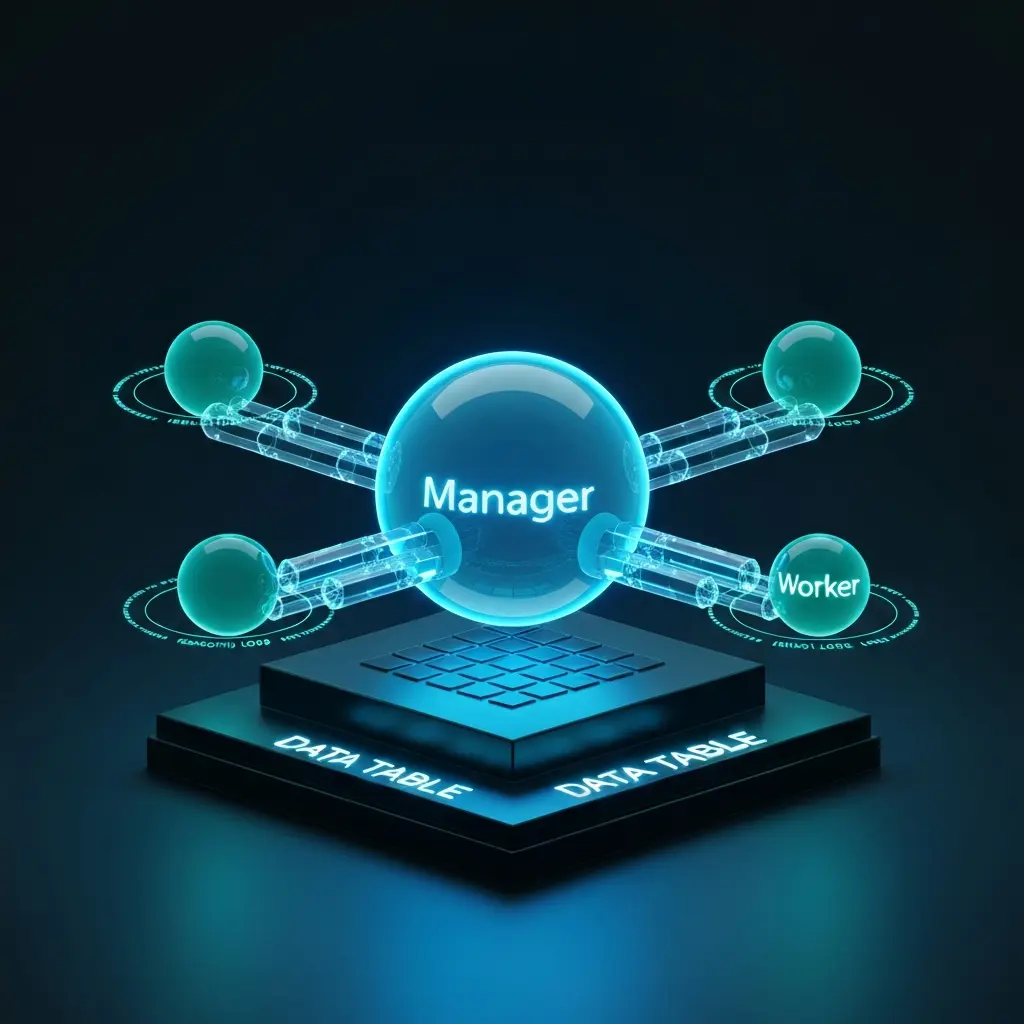
The most significant paradigm introduced is the formalisation of a Supervisor-Worker architecture. This design pattern, now a 2026 standard, uses a root ‘Supervisor Agent’ to decompose a high-level goal. It then delegates specific sub-tasks to specialised ‘Worker Agents’ via the ‘Workflow as a Tool’ feature. This modular approach reduces LLM prompt overhead by an estimated 40%, as each worker operates with a focused context, and the supervisor manages the strategic flow. Crucially, this architecture requires agents to remember past interactions. n8n v2.11 provides native integrations for PostgreSQL and Redis as memory backends, ensuring conversation history and agent state persist through server restarts and horizontal scaling events.
// Conceptual structure of a Supervisor Agent delegating a task
const tools = await supervisorAgent.getAvailableTools();
// 'Research Specialist' is a separate, published workflow exposed as a tool
const researchTool = tools.find((tool) => tool.name === 'Research Specialist');

const taskResult = await supervisorAgent.executeTool(researchTool, {
  query: 'Latest Q3 2026 projections for quantum-resistant cryptography adoption',
});
// taskResult contains the structured output from the Worker Agent's workflow
Pro Tip: Structure your Supervisor Agent’s prompt to explicitly define the roles of available Worker Agents. For example: “You are a project manager. You have a research specialist for data gathering and a compliance officer for risk assessment. Delegate tasks accordingly.” This role-based instruction significantly improves delegation accuracy.
For a deeper dive into workflow tooling, refer to the official n8n documentation on AI Agent nodes.
Engineering for Safety: Human-in-the-Loop and Task Isolation
Moving agents from demo to deployment hinges on safety. n8n v2.11 introduces native Human-in-the-Loop (HITL) logic via a new Chat Node action: ‘Send a message and wait for response’. This allows a workflow to pause execution asynchronously, present a decision, data point, or draft to a human for verification, and only resume upon receiving an approved input. This mechanism is critical for preventing hallucination loops in critical processes like financial reporting or customer communication, inserting a deterministic gate in an otherwise non-deterministic system.
Concurrently, the update hardens the execution environment. Custom JavaScript and Python code now run in dedicated, sandboxed Task Runners by default. This isolation protects the core n8n instance from memory leaks, infinite loops, or arbitrary code execution vulnerabilities originating from within an agent’s logic. It ensures a faulty or compromised worker agent cannot bring down the entire orchestration platform.
Pro Tip: Use the HITL action not just for approval, but for ambiguity resolution. Configure your agent to pause and ask clarifying questions when its confidence score for a decision is below a defined threshold, thereby improving overall system reliability.
Performance and Operational Resilience
Underpinning these new capabilities is a reconstructed performance foundation. The implementation of a high-performance SQLite pooling driver within the v2.x architecture grants self-hosted instances up to 10x greater database throughput for concurrent executions compared to v1.x. For high-frequency agentic systems, features like ‘Workflow History Compaction’ and ‘Instance ID Caching’ optimise data storage and retrieval, reducing latency. Operationally, the ‘Draft vs. Published’ paradigm, established in v2.0, is essential for MAS development. It allows teams to iterate on complex agent logic in a draft workflow without disrupting the live, published agents running in production, enabling true CI/CD for automation.
Furthermore, v2.11 enhances operational security with multi-environment secret management. Engineers can now configure multiple connections per external secrets provider (e.g., AWS Secrets Manager, HashiCorp Vault), enabling granular credential scoping. Development agents can use a restricted set of API keys, while production agents access the full suite, all managed centrally outside the workflow code.
Why Does Token Optimisation and RAG Integration Matter for Scale?
Cost and context are the twin constraints of scaling MAS. n8n v2.11 addresses both strategically. Token optimisation is now built into chained AI requests, allowing selective model invocation. A workflow can use a smaller, cheaper model like GPT-4o-mini for initial triage and routing, reserving a more powerful model like Claude 3.5 Sonnet for deep reasoning tasks. This tiered approach can reduce API costs by 30-50% in complex orchestrations. For knowledge, native Vector Store nodes for systems like Qdrant and Supabase integrate directly with the AI Agent node, enabling semantic retrieval (RAG) within the workflow.
This allows an agent to query a vector database and inject relevant, sub-millisecond context into its prompt dynamically. The agent is no longer limited to its initial training data or a small, static prompt context; it can access a vast, updated organisational knowledge base in real-time, making it genuinely expert.
// Example of context injection from a Vector Store node
const vectorStoreResult = await queryVectorStore({
  store: 'Company_Knowledge_Base',
  query: userQuestion,
  topK: 3,
});

const context = vectorStoreResult.map((doc) => doc.content).join('\n\n');
const finalPrompt = `Answer based on this context:\n${context}\n\nQuestion: ${userQuestion}`;
// finalPrompt is sent to the LLM
The 2026 Outlook: Towards Autonomous Organisational Units
The trajectory set by n8n v2.11 points towards a near future where MAS evolve from executing tasks to managing semi-autonomous business functions. We predict the emergence of standardised architectural blueprints—akin to microservices patterns—for common agent teams (e.g., customer onboarding, IT incident response). The focus will shift from building single agents to composing and governing these pre-defined agentic units. Furthermore, expect tighter integration between orchestration layers (like n8n) and real-time data streams and enterprise event buses, enabling agents to act not just on request, but proactively on signals from across the digital organisation.
Key Takeaways
- n8n v2.11 formalises the Supervisor-Worker architecture as a core pattern for efficient, modular Multi-Agent Systems, drastically reducing prompt overhead.
- Production safety is enabled by native Human-in-the-Loop actions for critical decisions and default sandboxed Task Runners for code isolation.
- Stateful, long-term memory via PostgreSQL/Redis is now native, making persistent agent conversations and horizontal scaling feasible.
- The Draft vs. Published workflow model and multi-environment secrets are essential for implementing proper development lifecycles and security in MAS.
- Cost control at scale is achieved through selective model invocation and native Vector RAG integration for dynamic, knowledge-rich context.
Conclusion
n8n v2.11 represents a pivotal upgrade, transitioning the platform from a capable automation tool to a serious engineering environment for Agentic Orchestration. By providing the necessary architectural primitives for safety, state, performance, and cost, it allows technical leaders to design Multi-Agent Systems with a level of resilience previously reserved for custom-coded solutions. The shift is clear: agentic workflows are now a matter of infrastructure, not just experimentation. At Zorinto, we leverage these advanced orchestration capabilities to help clients design and implement robust, business-critical MAS that integrate seamlessly into their existing operational fabric.