· Web Architecture · 6 min read
React Native 0.86-rc & Android 17 Shape Agentic Mobile Architectures
React Native 0.86-rc's Suspense for animations and Android 17's Agentic Automation are forging architectures where UI orchestration and AI-driven task execution converge.

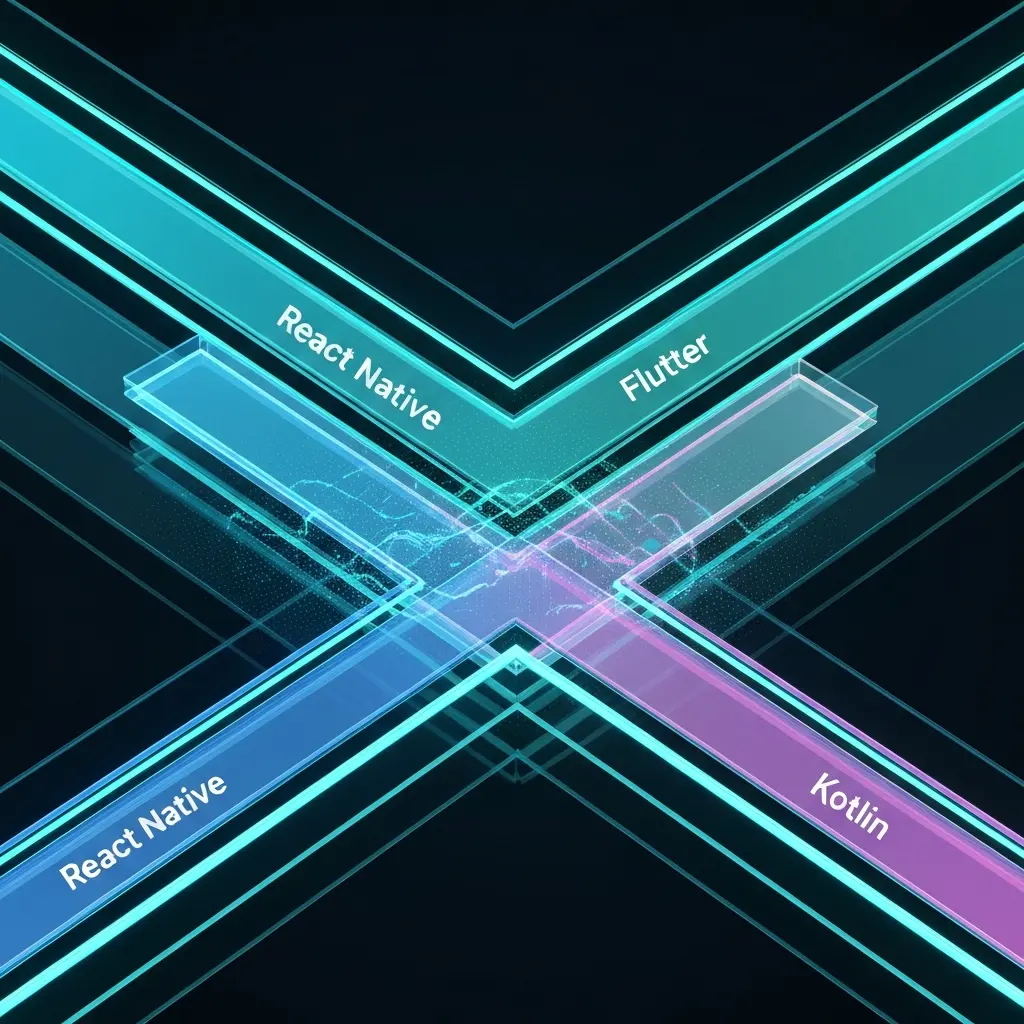
TL;DR: React Native 0.86-rc stabilises Suspense for animations, preventing UI thread stalls. Android 17’s Agentic Automation framework empowers Gemini Nano to execute multi-step tasks. These updates, alongside Flutter’s WasmGC, form the bedrock of agentic mobile architectures for 2026.
Introduction
The mobile architectural landscape in 2025 was characterised by reactive interfaces and manual task execution. The UI thread would often block during asset loads, and complex user workflows remained a linear sequence of taps and swipes. This paradigm is undergoing a fundamental shift towards proactive, intelligent systems. The concurrent releases of React Native 0.86-rc on May 7th and the impending announcement of Android 17’s Agentic Automation at Google I/O on May 12th signal a pivot. These are not isolated feature updates; they are complementary pillars of a new architecture where the UI seamlessly orchestrates complex sequences and the OS autonomously fulfills user intent.
What is React Native 0.86-rc?
React Native 0.86-rc.0 is the release candidate for version 0.86, officially integrating Concurrent Rendering features, specifically Suspense, into the Animation Backend. This enables the UI thread to coordinate and render complex graphic sequences without freezing or dropping frames during asynchronous asset loading operations. It represents a critical maturation of React Native’s rendering model, directly addressing performance bottlenecks in visually rich applications.
Why is the Suspense Integration for Animation a Game-Changer?
Prior to this integration, loading a high-resolution texture or a vector graphic within an animation sequence could cause the main UI thread to block. The renderer would wait for the asset, leading to perceptible frame drops or a frozen interface. With Suspense officially supported in the Animation Backend, the renderer can now ‘pause’ the visual state of a loading component and continue rendering the rest of the animated scene.
The mechanism allows developers to declaratively mark which parts of their animation depend on asynchronous data. The backend then manages the fallback states and seamlessly resumes the animation once the data resolves. This is not merely a smooth loading indicator; it enables the construction of intricate, multi-stage animations where assets load in parallel without disrupting the visual narrative.
Pro Tip: Use Suspense boundaries strategically around discrete animation elements, not the entire sequence. This allows for granular control and maintains performance for non-dependent parts of the scene.
How Does Android 17’s Agentic Automation Framework Work?
Android 17 introduces a native OS-level framework called ‘Agentic Automation’. It allows applications to register predefined, multi-step tasks—such as “archive these three project files, then email the summary to the team”—for the on-device Gemini Nano model to execute autonomously. This shifts the execution model from user-driven, step-by-step interaction to goal-driven, agent-assisted completion.
From an architectural perspective, your app defines a task schema, which includes the sequence, required permissions, and expected outcomes. The framework then manages the execution, handling context switching, permission prompts, and error recovery within a secure, sandboxed environment. This turns the device into a proactive assistant, capable of completing compound tasks even when the app is not in the foreground.
// Example: Registering a task schema for Agentic Automation
val archiveAndEmailTask = TaskSchema(
    id = "project_archive",
    steps = listOf(
        Step(type = StepType.FILE_OPERATION, target = "archive"),
        Step(type = StepType.COMMUNICATION, target = "email_summary")
    ),
    requiredPermissions = arrayOf(Manifest.permission.WRITE_EXTERNAL_STORAGE),
    completionCallback = { result ->
        // Handle task completion status
    }
)
AgenticFramework.registerSchema(archiveAndEmailTask)
What Are the Performance Implications of Flutter’s WasmGC Target?
Flutter’s May 2026 roadmap confirms WebAssembly Garbage Collection (WasmGC) as the default compilation target. This technical pivot achieves logic execution speeds approaching 90% of native C++ performance while reducing bundle sizes by up to 40%. The significance lies in the convergence: high-performance logic execution is now possible within a portable, secure Wasm sandbox.
For agentic architectures, this means the complex decision-making logic of an AI agent or a sophisticated animation engine can be compiled to WasmGC. It runs at near-native speed, is securely isolated, and shares a common runtime across web and mobile platforms. This facilitates the development of performant, cross-platform agents that are not bottlenecked by interpreted languages or heavy virtual machines.
How Do Liquid Glass and New Profiling Tools Shape the UI Layer?
The leaked ‘Liquid Glass’ material system for iOS utilises real-time refraction and ‘Responsive Lensing’ to communicate UI hierarchy through simulated physical depth. Concurrently, React Native 0.86-rc introduces custom performance tracks for ‘Renderer operations’ in DevTools. These two developments address the same problem from different angles: optimising the perception and mechanics of the UI layer.
Liquid Glass provides a design language where depth and refraction intuitively guide user attention, crucial for interfaces managing concurrent human and agent interactions. The new React Native profiling tools allow micro-second measurement of the Fabric synchronous UI pipeline, ensuring that these sophisticated visual designs do not regress performance. Together, they enable interfaces that are both intelligible to users and efficiently renderable by the system.
Pro Tip: Correlate your DevTools renderer operation profiles with user interaction timelines. A spike in pipeline duration during an agentic task completion animation is a direct optimisation target.
The 2026 Outlook
By the end of 2026, Gartner predicts 40% of enterprise mobile apps will feature task-specific AI agents. The architectural foundation for this growth is now visible: React Native’s Suspense ensures the UI remains responsive during agent-led workflows. Android’s Agentic Automation provides the secure execution framework. Flutter’s WasmGC delivers the portable performance. The ‘Adaptive Everywhere’ initiative in Android 17 will further standardise these experiences across foldables and XR. The mobile interface is evolving from a passive canvas to an active, intelligent collaborator.
Key Takeaways
- Officially use React Native 0.86-rc’s Suspense for animations to decouple asset loading from UI thread execution, eliminating frame drops.
- Design your application’s multi-step workflows as formal task schemas ready for integration with Android 17’s Agentic Automation framework.
- Evaluate Flutter’s WasmGC target for compiling high-performance, cross-platform logic cores, especially for on-device inference engines.
- Utilise the new React Native DevTools custom tracks to perform micro-second profiling of the Fabric renderer, correlating data with user interaction events.
- Prepare your UI design system to incorporate depth and hierarchy cues, akin to Liquid Glass principles, to clearly communicate between user and agent-driven states.
Conclusion
The releases of React Native 0.86-rc and Android 17 are not incremental updates but coordinated shifts towards an agentic mobile architecture. The UI thread becomes an orchestrator, the OS becomes an executor, and the application logic achieves new levels of portable performance. This convergence demands a re-evaluation of how we structure state, design interfaces, and measure performance. At Zorinto, we are already assisting clients in refactoring their monolithic interaction flows into discrete, declarative tasks and orchestratable UI sequences, ensuring they are architecturally poised for this intelligent pivot.