· Web Architecture · 7 min read
Astro 6 Beta and Next.js 16 Lead Edge-Native Web Evolution in 2026
The January 2026 releases of Astro 6 Beta, Next.js 16, and SvelteKit establish a new benchmark for performance and security by unifying development and production runtimes.

📚 Part of our 2026 Astro 6 & Next.js 16 series. For the main head-to-head comparison, see our pillar article: Next.js 16.2 vs Astro 6.1 — The 2026 Framework Speed & Precision Race.
TL;DR: The January 2026 stable releases from Astro, Next.js, and Svelte have shifted the paradigm. By unifying development and production runtimes, introducing aggressive caching strategies, and hardening security at the framework level, they collectively redefine expectations for edge-native performance and developer experience.
Introduction: The Fidelity Problem in Modern Web Engineering
For years, a critical schism has plagued web development: the stark difference between the local development environment and the production runtime, particularly on the edge. Developers build against Node.js but deploy to isolated, serverless environments like Cloudflare Workers or Vercel Edge Functions. This dissonance leads to subtle, often catastrophic bugs that only surface post-deployment—a ‘works on my machine’ failure at a global scale. The architectural problem was one of runtime fidelity. The January 2026 wave of releases, spearheaded by the Astro 6 Beta, Next.js 16, and SvelteKit, directly attacks this core issue. They are not merely adding features but re-engineering the foundation to ensure the primitives used during development are identical to those in production, thereby eliminating a whole class of deployment failures and performance regressions.
What is the 2026 Edge-Native Framework Shift?
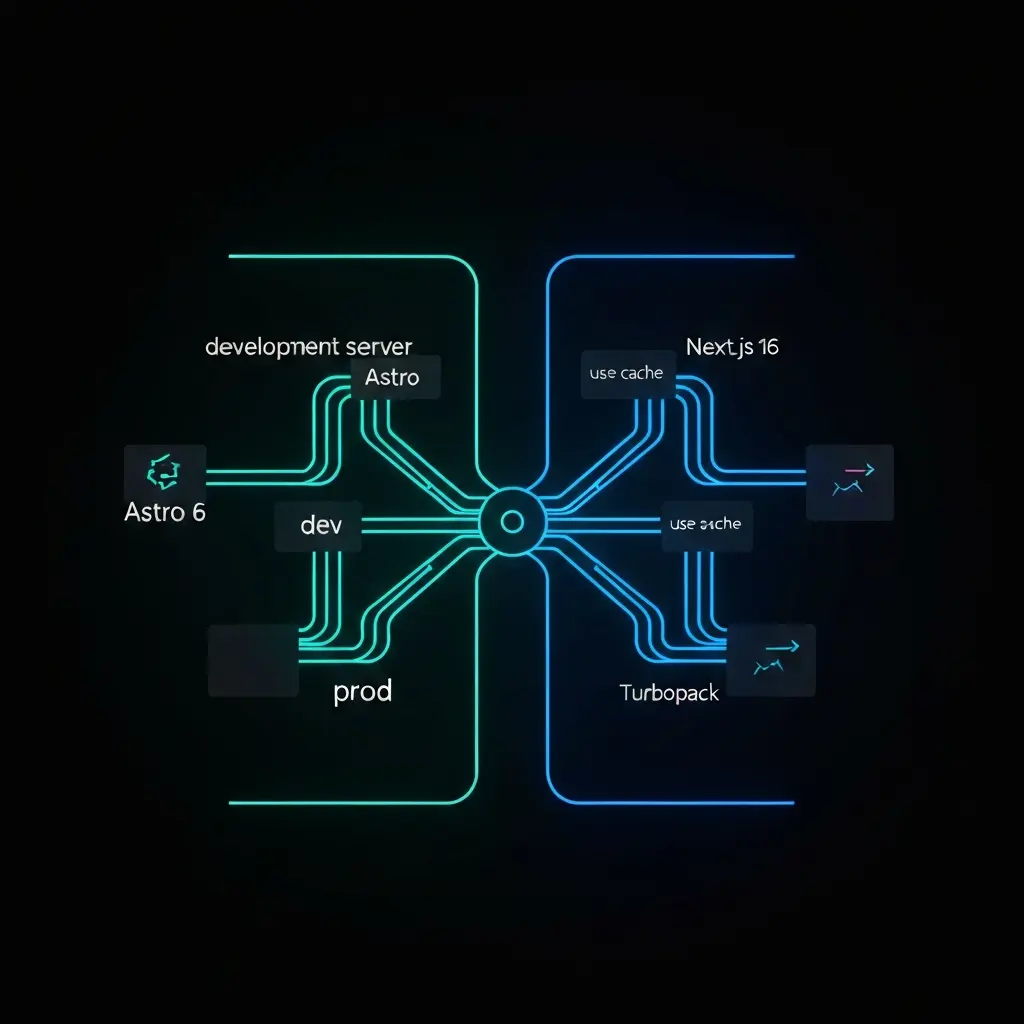
The 2026 edge-native framework shift represents a fundamental architectural realignment where development tooling and production infrastructure converge. This movement, exemplified by the Astro 6 Beta’s use of Vite’s Environment API and Next.js 16’s stable Turbopack, ensures that the same low-level runtime APIs (for network, file system, and caching) are utilised identically in both local development and global edge deployments. The goal is to provide perfect fidelity, making the development server a true, high-fidelity simulator of the edge production environment. This eliminates environment-specific bugs and allows developers to confidently optimise for performance characteristics that will be consistent post-deployment.
The End of Runtime Schism: Development/Production Fidelity
A core breakthrough in early 2026 is the explicit effort to collapse the distinction between development and production. The Astro 6 Beta has redesigned its dev server to leverage Vite’s Environment API. This means that when you run astro dev targeting a Cloudflare Workers adapter, the local server uses the same Workers runtime primitives as the live site. Next.js 16 achieves similar goals with its stable Turbopack rollout, which is inherently designed for the same bundled output in dev and build. The practical impact is profound: you can now locally test edge-specific behaviours like KV store interactions or dynamic routing with absolute confidence.
// Astro 6 Beta configuration example for edge-runtime fidelity
import { defineConfig } from 'astro/config';
import cloudflare from '@astrojs/cloudflare';

export default defineConfig({
  adapter: cloudflare({ runtimeMode: 'local' }), // Uses local Workers runtime
  output: 'server',
});
Pro Tip: When configuring a project, explicitly set the runtime mode to ‘local’ for your adapter. This forces the development server to load the actual production runtime polyfills, catching compatibility issues early.
This architectural shift, detailed in the Vite Environment API documentation, moves us from emulation to direct execution. The business value is clear: a drastic reduction in environment-specific bugs, faster deployment cycles, and more reliable performance profiling during the development phase.
Next-Level Caching & Data Coherence Strategies
Performance optimisation has moved beyond simple CDN caching into sophisticated framework-level data management. Next.js 16 introduces two pivotal features: Layout Deduplication and the updateTag() API. Layout Deduplication solves a common inefficiency in client-side navigation. For an e-commerce page with 50 prefetched product links, the shared layout (header, nav, footer) is now downloaded exactly once, not 50 times. This drastically reduces network transfer size and improves interaction latency.
The updateTag() API introduces “read-your-writes” semantics to the Next.js data cache. Traditionally, after a user action (like posting a comment), there was a stale interval before the cache reflected the change. Now, cache invalidations are immediately visible on the next navigation, ensuring a synchronous user experience. This is critical for applications requiring real-time data coherence.
// Next.js 16 updateTag API example for immediate cache invalidation
import { revalidateTag } from 'next/cache';

// After a mutating action (e.g., form submission)
export async function action() {
  // ... update database
  revalidateTag('user-comments'); // This instantly updates the UI for the user's next view
}
Furthermore, Turbopack File System Caching (Beta) persists compiler artifacts to disk. For large enterprise monorepos, this can reduce cold start times for development servers by up to 10x, directly improving developer velocity and feedback loops.
Why Does Granular Security Now Belong to the Framework?
Frameworks in 2026 are taking proactive ownership of security, moving protection closer to the source. Astro 6 Beta now includes native route-guard middleware that automatically blocks direct URL access to sensitive project root files like package.json or README.md, returning a 404 by default. This eliminates a common oversight that could leak internal project details.
Simultaneously, Svelte 5.46.0 added a csp option to its hydration render function. When enabled, it automatically generates and injects Content Security Policy (CSP) compliant hashes for all inline scripts during server-side rendering. This fully automates one of the most tedious and error-prone aspects of CSP implementation, providing robust XSS protection without developer overhead.
// SvelteKit 2026: Automatically generating CSP nonces for hydration
// In your hooks.server.js
import { csp } from 'svelte/compiler';

export const handle = async ({ event, resolve }) => {
  const response = await resolve(event, {
    render: { csp: true }, // Framework handles hash generation
  });
  return response;
};
Pro Tip: Enable these security features from the outset of a project. Retroactive implementation is often more complex, and these defaults provide a strong security baseline with zero ongoing maintenance.
This trend signifies a maturation where frameworks provide secure-by-default configurations, allowing development teams to focus on business logic rather than constantly patching common security vulnerabilities. This proactive stance is documented in Svelte’s release notes for version 5.46.0.
The New Abstractions: From Middleware to Executables
The abstraction layer for backend logic is evolving to improve predictability and deployment flexibility. Next.js 16 has formally deprecated the traditional middleware.ts file in favour of proxy.ts. This renaming is more than semantic; it clarifies the network boundary and improves the predictability of edge function execution by defining a clearer, more specific contract between the application and the edge network.
Perhaps the most radical community-driven development is the trending SvelteKit ‘EXE’ Adapter. This adapter allows developers to compile a full-stack SvelteKit application—including its Node.js-based server logic—into a single, standalone executable binary. This enables deployment to environments without Node.js installed, simplifies distribution, and enhances security by encapsulating the entire application. Coupled with the Svelte CLI update (sv@0.11.0) providing zero-config parity for Cloudflare Workers, these updates exemplify the drive towards seamless, environment-agnostic deployment.
The 2026 Outlook: Consolidation and Specialisation
Looking ahead, the trajectory set in January 2026 points towards further consolidation of the development pipeline. We predict the complete absorption of build tools (like Vite and Turbopack) into being invisible, default services of the frameworks themselves. Edge runtime fidelity will become a non-negotiable standard, not a beta feature. Furthermore, we anticipate a rise in framework-level specialisation for specific data patterns—like real-time subscriptions or offline-first capabilities—directly integrated into routing and caching layers. The competition will centre not on feature checklists, but on the quality of the abstraction and the granularity of control offered to developers while maintaining exceptional out-of-the-box performance and security.
Key Takeaways
- Demand Runtime Fidelity: Configure your development environment to use the exact production edge runtime, as demonstrated by Astro 6 Beta, to eliminate deployment surprises.
- Leverage Framework Caching: Utilise new strategies like Next.js 16’s Layout Deduplication and
updateTag()API to minimise network transfers and ensure immediate data coherence. - Adopt Security Defaults: Enable built-in framework security features, such as Astro’s route guards and Svelte’s CSP automation, to establish a robust security baseline effortlessly.
- Evaluate New Deployment Abstractions: Consider the SvelteKit ‘EXE’ Adapter for simplified distribution and explore the clarified
proxy.tsmodel in Next.js for cleaner edge logic. - Prioritise Cold Start Performance: For large monorepos, the file system caching in Next.js 16’s Turbopack is critical for maintaining developer velocity.
Conclusion
The January 2026 releases mark a pivotal moment where our leading frameworks have moved from solving problems in the browser to re-architecting the entire pipeline around it. The focus is now on granular engineering: perfect fidelity between environments, intelligent data flow, and security baked into the foundation. This evolution reduces cognitive load for engineers and delivers more reliable, performant experiences to end-users. At Zorinto, we help engineering leaders navigate and implement these architectural shifts, ensuring their teams can leverage these breakthroughs to build more resilient and efficient web applications.