

SaaS development
SaaS development for founders and product teams
We take SaaS products from idea to paying customers — and keep building once they land. UK-based senior engineers, fixed-price milestones, and you own every line of code.

What a SaaS engagement includes
Everything a subscription product needs to charge money on day one — not just the features on the marketing page.
Structured discovery that turns your idea into a build plan: the workflows customers will pay for first, what to defer, and a fixed-price milestone map.
A production-grade first version — real auth, real billing, real data — designed to validate with paying customers, not a throwaway prototype.
Tenant isolation designed at the data layer from day one, so customer two hundred is as safe and as fast as customer one.
Subscriptions, upgrades, proration, and invoicing wired into Stripe or GoCardless — with tax handling and dunning treated as first-class features.
Sign-up, SSO where needed, team workspaces, and role-based permissions — the unglamorous plumbing that B2B buyers check before they sign.
CI/CD, zero-downtime deploys, error tracking, logging, and uptime monitoring in place before launch — so you find problems before customers do.
The staged path
From idea to first paying customer
You should not have to commit £100,000 before you know the product works. We stage SaaS builds so every phase earns the next one.
The most expensive mistake in SaaS is building the whole platform before anyone has paid for it. Our staged model exists to stop that: each phase is scoped, priced, and justified by what the previous one proved. We have delivered 75+ projects this way since 2019 — first as Criztec, now as Zorinto Ltd — with a 98% client satisfaction rate and a 5.0 Google rating, working from our Slough HQ with founders across the UK, Europe, and the US.
1. Scope the smallest sellable product
A short discovery sprint produces a domain model, a milestone plan, and a fixed quote. If the honest answer is that you should not build yet, we say so.
2. Ship the MVP — £18,000–£45,000
One or two core workflows, auth, billing, and an admin, live in front of real users in 6–10 weeks (complex multi-tenant builds can run to 16). Enough product to charge for; not a penny of speculative build.
3. Iterate towards the full platform
Once revenue validates the direction, we build out multi-tenancy at scale, integrations, and the deeper feature set. Full v1 platforms run £50,000–£150,000, staged across fixed-price milestones.
Proof: Ofyse
We designed and built Ofyse, a multi-tenant SaaS that runs coworking spaces end to end — bookings, member CRM, recurring billing with regional tax, and payments through Stripe, Razorpay, and GoCardless — delivered as a phased build over roughly four months.

Technology
Stack choices we default to
Boring, proven technology that ships fast and hires well. We recommend the framework that fits your team and your product — not the one that is fashionable this quarter.
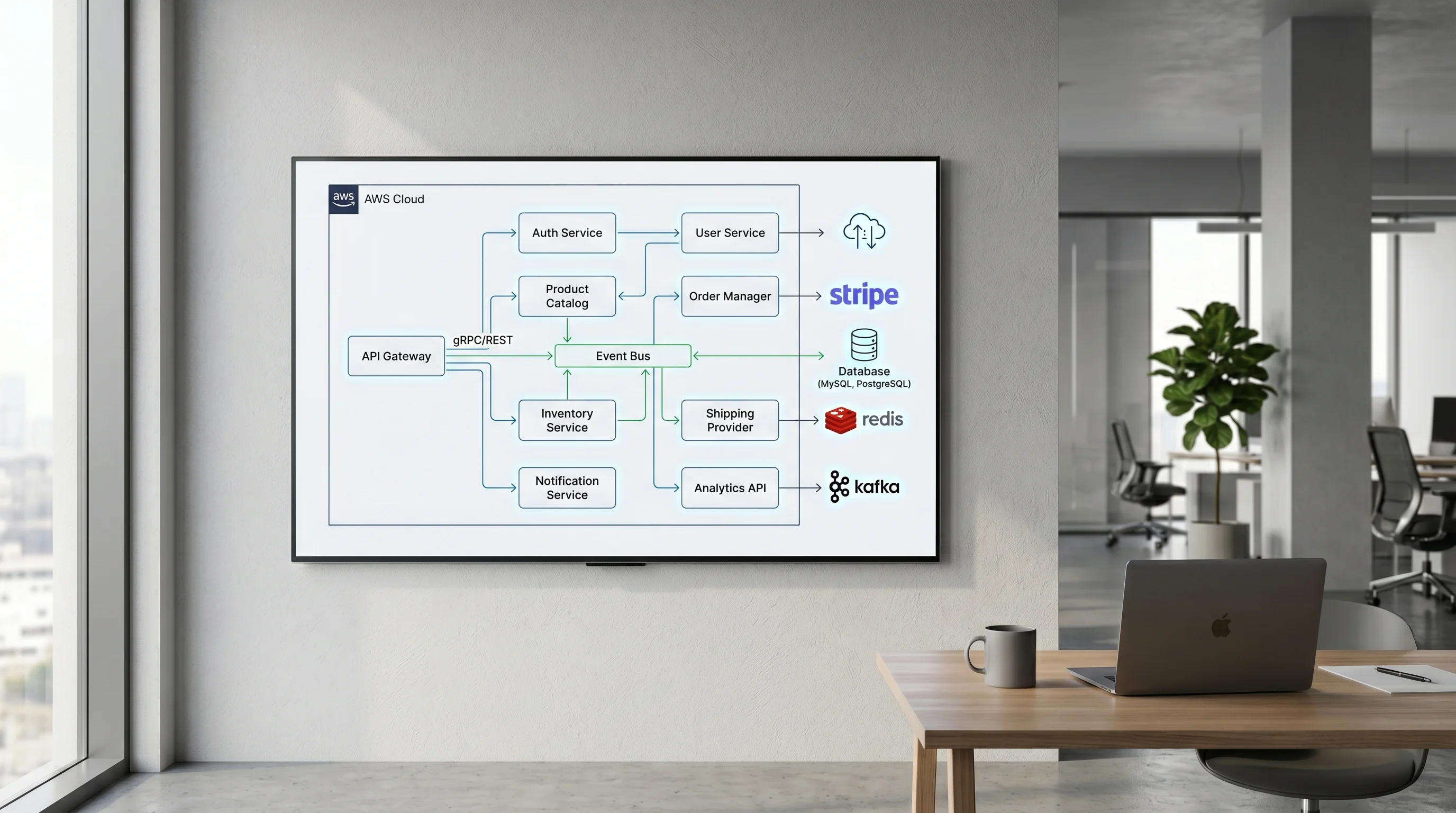
Backends are Ruby on Rails, Django, or Laravel on PostgreSQL — mature frameworks with more than a decade of security hardening, first-class billing and background-job tooling, and deep UK hiring pools. Frontends are server-rendered by default, with Next.js or Astro where a marketing site or product surface benefits from the edge. Every choice is made for the team who will maintain the product in year three, not for the demo in week three.
- Ruby on Rails development →Our pick for speed to market — SaaS is what Rails was made for.
- Django development →Python leverage for data-heavy SaaS, with a batteries-included admin.
- Laravel development →The PHP route — Cashier billing, Livewire UIs, rich SaaS tooling.
- Astro development →Fast marketing sites and docs that sit alongside your product app.
Delivery model
Predictable enough to plan a launch around; transparent enough that you always know where the budget went.
Fixed-price milestones
Every phase is quoted before it starts. No hourly meter, no scope surprises — if requirements change, we re-quote in writing before building.
Weekly demos on staging
Working software every week on a staging environment you can click through — progress you can see, not status reports you have to trust.
Continuous shipping
Two-week sprints, tested code, and increments deployed to production continuously — there is no risky big-bang release at the end.
30-day post-launch support
After go-live we stay on for 30 days to fix issues, tune performance, and hand over cleanly — included in the build price.
Ongoing product team
When the product finds traction, most founders retain us as their engineering team for the roadmap — monthly, flexible, and cancellable.
SaaS development FAQs
The questions founders ask us before committing to a build.
How much does SaaS development cost in the UK?
A realistic MVP — one or two core workflows, auth, billing, and an admin — lands between £18,000 and £45,000. A full v1 SaaS product with multi-tenancy, subscription billing, roles, and four or five feature areas runs £50,000–£150,000. We fix-price each milestone after discovery, so there is no open-ended hourly meter. See our pricing page for the full breakdown across services.
How long does it take to build a SaaS MVP?
A focused MVP typically ships in 6–10 weeks; more complex multi-tenant builds with billing can run to 16 weeks, depending on how many workflows genuinely need to exist at launch. You will see working software on staging from the first sprint, with weekly demos throughout. The single biggest factor is scope discipline: products that launch fastest are the ones where we cut ruthlessly to the workflow a customer would actually pay for, and defer everything else to the post-launch backlog.
Who owns the code and IP?
You do — in full. Source code, infrastructure access, and all IP are assigned to you in writing as part of our contract, and we work in your GitHub or GitLab from day one. If you move to an in-house team or another supplier later, nothing proprietary locks you in.
How do you choose the tech stack?
We default to boring, proven technology: Ruby on Rails, Django, or Laravel on the backend with PostgreSQL, and Next.js or Astro where the frontend justifies it. The deciding factors are your team (what you can hire for and maintain), your domain (data-heavy problems lean Python), and your launch pressure. We never pick a stack to make our lives interesting at your expense.
What happens after launch?
Every build includes 30 days of post-launch support. Beyond that, most founders keep us on as an ongoing product team — typically £6,000–£20,000/month depending on team shape — covering new features, upgrades, security patches, and performance work. Retainers are monthly and cancellable with notice; there is no long lock-in.
Do you take equity instead of fees?
No. We are a fee-for-service software development company — we charge for the work and you keep 100% of your company. We think that is the honest arrangement: you get a motivated engineering partner with no claim on your cap table, and we stay accountable to delivery rather than to a speculative upside.
Scope your SaaS with a senior engineer
Tell us about your product, your users, and your launch pressure — we will come back within one working day with an honest read on scope, cost, and the fastest route to revenue.